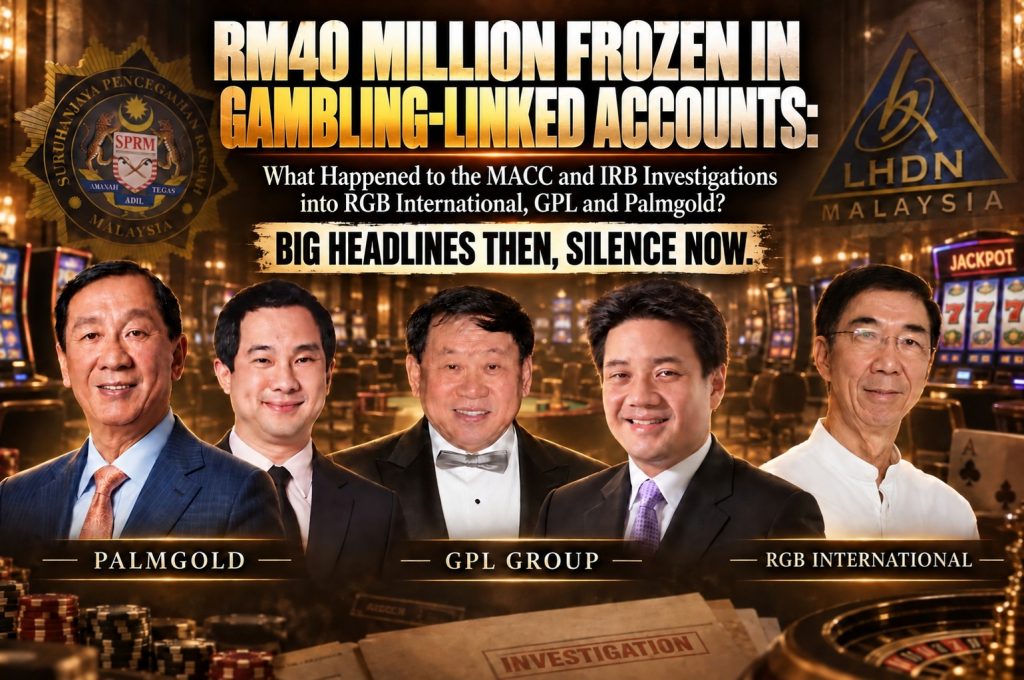
KUALA LUMPUR — More than three years after the Malaysian Anti-Corruption Commission’s August 2023 operation involving gambling companies, the country’s gaming-machine supply and gambling industries are still waiting for answers. The raids were linked to allegations of bribery and the channelling of political funds during Malaysia’s 15th General Election.
Among the companies thrust into the spotlight was RGB International Berhad, a Bursa Malaysia-listed company involved in the supply of electronic gaming machines and casino equipment, technical support, and the operation of gaming-machine concessions.
Its managing director, Datuk Seri Chuah Kim Seah, and its then independent non-executive director, Tan Sri Norazman Hamidun, were reportedly among those detained to assist with the investigation. RGB confirmed that Chuah had been detained by the MACC before being released on bail.

Thirteen People, Including Gambling Tycoons, Detained; RM40 Million in Accounts Frozen
During the operation targeting gambling companies, the MACC reportedly detained 13 individuals—including prominent corporate figures carrying the titles Tan Sri and Datuk Seri—to assist in an investigation into alleged bribery by several gambling companies.
Accounts belonging to individuals and companies, estimated to contain RM40 million, were also reportedly frozen. At the time, the MACC was said to be tracking several individuals believed to be overseas.

The operation was subsequently linked to several major businesses in the recreational-club, slot-machine and electronic-gaming sectors, including GPL Group Sdn Bhd and Palmgold Corporation Sdn Bhd.
GPL Group has been associated with Tan Sri Dato’ Cheng Joo Teik and his son, Datuk Douglas Cheng, while Palmgold Corporation has been linked to Tropicana Corporation Berhad founder Tan Sri Danny Tan Chee Sing. The name of the late Tan Sri Ta Kin Yan, founder of Waz Lian Group, also surfaced in reports concerning the gaming-machine business network. The reports said individuals were detained for investigation, while some persons sought by the authorities were believed to have left the country.

GPL Group Sdn Bhd — Tan Sri Dato’ Cheng Joo Teik and Datuk Douglas Cheng
Who in the industry has not heard of GPL Group Sdn Bhd, the group associated with Tan Sri Dato’ Cheng Joo Teik and his son, Datuk Douglas Cheng? GPL is no minor name in the gambling and gaming business. Its reported network encompasses entertainment outlets, karaoke centres, gaming centres and premises operating under the banner of “sports and recreational clubs” in Malaysia and abroad.


Documents dated June 28, 2024, for the financial year ended December 31, 2023, show that GPL Group had share capital of just RM2. For that year, the company recorded revenue of only RM15,000, a pre-tax loss of RM661,535 and an after-tax loss of RM662,021. Its accumulated losses stood at RM490,286.
At the time, GPL Group had total assets of approximately RM2.42 million, comprising RM1.84 million in non-current assets and RM572,400 in current assets. Its current liabilities, however, had reached RM2.98 million—already exceeding the company’s total assets.

The picture did not improve in the latest financial records for the year ended December 31, 2025. GPL Group’s revenue surged to RM1.13 million, but the company still recorded pre-tax and after-tax losses of approximately RM1.08 million each. Accumulated losses more than tripled to RM1.52 million.
Over the same period, total assets rose to about RM4.35 million, but current liabilities also jumped to RM6.50 million. In other words, current liabilities exceeded the company’s entire asset base by approximately RM2.15 million. An almost 75-fold increase in revenue from the earlier figure did not translate into profit. Instead, the after-tax loss increased by approximately RM414,385.
GPL Group’s management structure also changed. Earlier Companies Commission of Malaysia records listed Tan Sri Dato’ Cheng Joo Teik and Dato’ Lim Kim Huat as directors from December 1, 2008. The latest records, however, no longer list Cheng as a director. His position on the board is now occupied by Datuk Douglas Cheng Heng Lee, appointed on September 3, 2025, while Dato’ Lim remains a director.
Although no longer a director, Cheng still holds one of GPL Group’s two shares. The other is held by Dato’ Lim. Each therefore owns 50% of the company, while Datuk Douglas Cheng serves as a director but is not listed as a direct shareholder.
According to the records cited, the GPL network is said to operate more than 54 sports, recreational, gambling and entertainment centres. That figure does not include allegations concerning online gambling or unlicensed operations said to be connected to the group.

If GPL’s business network is truly that extensive, why does its holding company continue to report losses, negative equity and liabilities exceeding assets? Is most of the operating income recorded through subsidiaries or other entities in the network? What expenses caused RM1.13 million in revenue to end in a RM1.08 million loss?
SSM records alone do not prove tax evasion. But a sudden surge in revenue, widening losses, share capital of just RM2 and a multilayered corporate structure are red flags that deserve deeper scrutiny by the Inland Revenue Board and other enforcement agencies. Is GPL using cash-based transactions or other structures that obscure the full extent of its income? That question requires a forensic audit, not silence.
DATUK DOUGLAS CHENG HENG LEE — TREC
Datuk Douglas Cheng is also the founder and chairman of the RM323 million TREC project, described as Malaysia’s largest integrated lifestyle and entertainment hub.
TREC Holdings Sdn Bhd, formerly Avant City Sdn Bhd, was incorporated on 17 January 2013 with issued share capital of RM350,000. The active company’s principal activities are property rental and maintenance. Its business address is Lot 438, Jalan Tun Razak, Kuala Lumpur—the site of the TREC entertainment and lifestyle development.
The board of TREC Holdings comprises Ng Cher Yong, Datuk Douglas Cheng Heng Lee, Phoa Tai Han, Roy Ho Yew Kee and Tan Thiam Chai. Ng and Douglas are its longest-serving directors, having been appointed when the company was incorporated on 17 January 2013. Phoa joined the board on 31 December 2018, while Roy Ho and Tan were appointed in 2023.
Sandraruben A/L Neelamagham was appointed an alternate director on 28 November 2024. The controversial figure known as “Mr R” has been linked in earlier reporting to corporate power struggles and described as a close associate of Datuk Seri Farhash. He is now deputy chairman of HeiTech Padu Berhad. Does Sandraruben’s appointment strengthen Douglas Cheng’s position at TREC?

Modern Falcon Sdn Bhd is TREC Holdings’ largest shareholder, with 122,500 shares, or 35%. Daman Land Sdn Bhd holds 115,500 shares, or 33%, followed by Jernih Wiramas Sdn Bhd with 105,000 shares, or 30%. Phoa Tai Han directly owns the remaining 7,000 shares, or 2%. In other words, three corporate entities control 98% of TREC Holdings, while an individual directly holds just 2%.
For the financial year ended 30 June 2025, TREC Holdings reported revenue of RM25.30 million, profit before tax of RM6.53 million and profit after tax of RM5.14 million. Its after-tax profit margin was approximately 20.3%. The figures show that its property rental and maintenance operations generated a substantial return that year.
The company recorded total assets of approximately RM69.45 million against liabilities of around RM57.12 million, leaving net assets of roughly RM12.32 million. Its liabilities nevertheless amounted to about 82% of total assets. Current liabilities stood at RM16.39 million, while non-current liabilities totalled RM40.73 million.
TREC Holdings also reported retained earnings of RM9.11 million and declared a net dividend of RM6 million—approximately RM857,000 more than its profit after tax for the year. The dividend may therefore have drawn on accumulated profits from earlier years as well as its 2025 earnings. Despite the company’s profitability, the size of the payout and its substantial liabilities warrant a closer examination of cash flow and long-term financial capacity.
In conclusion, TREC Holdings was profitable in 2025, with assets exceeding its liabilities. However, one financial year alone is insufficient to determine whether its performance is improving or declining. A comparison with its 2023 and 2024 accounts is needed to assess trends in revenue, profit, debt and cash flow more fully.

TREC is plainly a profitable venture associated with Douglas Cheng. But could its business also be used to launder money? That is a serious question requiring evidence from financial transactions and an investigation; the company accounts cited here do not establish that it has happened.
MYTECH GROUP BHD : TAN SRI DATO’ CHENG JOO TEIK & DATO’ DOUGHLAS CHENG
Beyond GPL Group, Tan Sri Dato’ Cheng Joo Teik and Datuk Douglas Cheng are also the largest shareholders of MyTech Group Bhd. All gambling proceeds are laundered through MyTech. Previously, MyTech’s second-largest shareholder was TS Wong, founder of MYEG Services Bhd—Zetrix AI—but he has since sold the stake to Tan Sri Dato’ Cheng Joo Teik and Datuk Douglas Cheng.

Tan Sri Dato’ Cheng Joo Teik and his family are now MyTech Group Bhd’s controlling shareholders through Gain Millen Sdn Bhd. Gain Millen is 80% owned by Cheng, while his sons, Datuk Douglas Cheng Heng Lee and Andrew Cheng Heng Jin, each hold 10%. Based on the latest records cited, Gain Millen owns approximately 50.7% of MyTech, while Cheng’s total interest together with parties acting in concert was reported at 56.09%.

This structure gives the Cheng family effective control of MyTech, although the holdings are arranged through a family investment company and several direct interests. Datuk Douglas Cheng is also an executive director of MyTech and was listed as a party acting in concert in the company’s mandatory takeover offer.
Once again, the financial pattern surrounding an entity linked to GPL’s owners raises questions. Although assets and revenue increased, liabilities also climbed until they exceeded the company’s entire asset base.
In Gain Millen’s case, the company recorded a small profit, but its financial position remained weak. Current liabilities stood at RM25.86 million, while total assets amounted to only RM23.37 million, producing a net asset deficiency—or negative equity—of approximately RM2.49 million.
Its ability to meet short-term obligations also appeared strained. Current assets amounted to just RM1.35 million against current liabilities of RM25.86 million, equivalent to a current ratio of approximately 0.05 times. Put simply, for every RM1 in current liabilities, Gain Millen had only about five sen in current assets.
More strikingly, approximately RM22.02 million, or 94% of its total assets, was classified as non-current assets. That is a material consideration for an investment-holding company controlling more than 50% of MyTech Group Bhd.
PMX Had Already Taken Aim at GPL Group Sdn Bhd
Before becoming Malaysia’s 10th prime minister, Datuk Seri Anwar Ibrahim called on the government and the Ministry of Finance in November 2021 to investigate the involvement of Malay Muslims in gambling activities. Anwar said Muslims were believed to comprise 45% of the membership of 62 gambling clubs.
He also urged the Royal Malaysia Police to investigate the involvement of an individual known as Douglas Cheng of GPL Group, who was alleged to operate freely and control a large number of gambling companies in the country.
“The freedom enjoyed by GPL Group could draw Malays, perhaps those from the upper class, into these gambling activities.
“I also want the Inland Revenue Board to review GPL Group’s position so that it can be monitored and action taken,” he said.

From 2023, the MACC launched raids on gambling companies, including GPL Group, and RM40 million in bank accounts was reportedly frozen. Yet the public has still not received a full accounting of what followed.
The MACC and the IRB were expected to act against GPL Group Sdn Bhd. Did they?
PALMGOLD CORPORATION SDN BHD — TAN SRI DANNY TAN CHEE SING
Another well-known gambling company that also evaded tax is Palmgold Corporation Sdn Bhd, owned by Tan Sri Danny Tan Chee Sing—the younger brother of Tan Sri Vincent Tan, owner of Tropicana Corporation Bhd and an executive director of Sports Toto Berhad under Berjaya.


Palmgold is run by Tan Sri Danny Tan Chee Sing’s son, Dato’ Dickson Tan Yong Loong.


Palmgold’s FY2025 financial performance presents a mixed—and troubling—picture. Revenue plunged by 96%, from RM4.98 million in FY2023 to just RM198,505. Such a collapse suggests that the company’s core activities had contracted sharply or were no longer generating meaningful revenue.
Despite that, Palmgold recorded an after-tax profit of RM209,213, an increase of 135.6% from RM88,790 in FY2023. The figure demands scrutiny because the FY2025 profit exceeded the company’s reported revenue. Based on the available information, this may have resulted from other income, an exceptional gain or an accounting adjustment. The SSM financial summary does not identify the source, however, so the increase in profit cannot be treated as evidence that the company’s core operations had recovered.
Its balance sheet remained weak. Total assets fell by 56.7%, from RM2.29 million to RM994,223. Although current liabilities declined by 12.7% to RM11.39 million, they still exceeded the company’s total assets by more than 11 times. Palmgold also remained in a negative-equity position of RM10.40 million, an improvement of only about RM361,395 from negative RM10.76 million in FY2023. Accumulated losses remained substantial at RM10.98 million, while share capital stayed at RM575,000.
In short, Palmgold recorded a paper profit in FY2025, but its financial foundations showed no convincing recovery. Collapsing revenue, shrinking assets, excessive current liabilities and negative equity portray a company still under severe financial pressure.
A Disturbing Pattern Among Gambling-Linked Companies
The financial pattern of these two gambling-linked companies contains warning signs that warrant investigation for possible tax evasion: operating revenue is either shrinking or remarkably small, profits do not appear to correspond with reported revenue, while accumulated losses and liabilities remain high.
It is difficult to reconcile such figures with businesses associated with high-volume cash flows. But these patterns are red flags, not conclusive proof. The IRB must audit cash flows, related-party transactions, directors’ and shareholders’ accounts, and income that may have been shifted to other entities to determine whether actual profits were concealed or tax was evaded.
From the MACC to an Alleged IRB Cartel
On October 27, 2024, The Corporate Secret raised allegations that companies operating recreational clubs and gaming-machine businesses had failed to declare their full income and had evaded taxes allegedly amounting to hundreds of millions of ringgit.
Two days later, on October 29, 2024, The Corporate Secret reported that the Inland Revenue Board had conducted operations against GPL Group and Palmgold Corporation.
According to that report, the operation sought documents and information concerning income, business transactions and possible non-compliance in the companies’ financial reporting.
The report also alleged that related companies operated numerous premises or branches while continuing to report losses—a situation that raised obvious questions about whether the scale of their operations was consistent with the amount of tax paid.
Major Raids—but Were the Outcomes Buried?
Nearly two years after the reported IRB operation, no verifiable official statement has been found disclosing the amount of any additional assessments, penalties or court action involving GPL Group and Palmgold Corporation.
It remains unknown whether the two companies:
- received additional tax assessments;
- paid arrears or penalties;
- appealed against any IRB decision;
- reached an administrative settlement;
- were charged with any offence; or
- were cleared of the allegations after the audit was completed.
Why have all these investigations—from the MACC to the IRB—become a mystery? Under Tan Sri Azam Baki, gambling companies managed to negotiate with him, while an officers’ cartel within the IRB released these gambling companies. Who are they?
Did an IRB Officers’ Cartel Close the Gambling Tycoons’ Cases?
As the government loses billions of ringgit in tax revenue, allegations have emerged that a small group of senior IRB officers used their positions to delay investigations and weaken enforcement action. According to sources cited in earlier reports, this alleged cartel acted as an intermediary—negotiating with non-compliant companies before influencing the IRB’s top management to close cases, reduce penalties or grant more lenient settlements.
More disturbing are allegations that certain files were deliberately withheld from the investigation division, preventing immediate action. Intervention by officers at different levels was allegedly responsible for cases being delayed, stalled or disappearing from the enforcement radar. If true, this would no longer be an ordinary administrative failure. It would point to a structured mechanism designed to protect parties that failed to pay tax.
The Corporate Secret possesses the companies’ bank statements, which clearly show that they should have paid tax but succeeded in “settling” the matter with officers from the IRB cartel.
Based on allegations published in several earlier blogs, Datuk Khairul Halimin Abdul Halim—identified as a deputy chief executive officer associated with the Special Branch—and Mathan Kaliappan were among the officers named in complaints concerning the alleged cartel. Troubled companies were said to deal with them first before matters were taken to the IRB chief executive officer.

The questions are unavoidable: In what official capacity were such meetings and negotiations conducted? Which companies benefited? How much public revenue was reduced, compromised or written off?
Mathan Kaliappan was also alleged to wield influence over civil cases involving gambling tycoons and major companies facing tax claims. Allegations that multimillion-ringgit cases could be “settled” outside the proper channels cannot simply be swept under the carpet. The IRB cannot be allowed to harbour a “little Napoleon” who is allegedly able to decide which companies are pursued and which are given an escape route.

If these allegations are untrue, the IRB should issue an open and detailed explanation. But if there is any basis to them, an independent investigation must examine every file handled, every reduction in penalties, every decision not to prosecute and every communication with the companies concerned. Tax collectors cannot become protectors of companies that deprive the country of revenue.
Ordinary taxpayers should not be barred while powerful tycoons are invited to negotiate. The IRB can impose travel restrictions on individuals with tax arrears. Ordinary taxpayers are pursued through notices, penalties, deductions and legal action. Yet large companies with money, influence and access are alleged to be able to enter a negotiation room and emerge with a far lighter burden.
In 2023, more than 180,000 individuals were reportedly subjected to travel restrictions over tax arrears worth billions of ringgit. During the same period, the IRB also identified RM5.2 billion in additional assessments involving undeclared income by individuals and companies.
Against tax leakage on that scale, allegations that insiders can “settle” selected files do more than stain the IRB’s reputation. They raise the possibility that Malaysia has lost revenue that should have funded schools, hospitals, public transport and assistance for the people.
The MACC is urged to investigate every allegation concerning an IRB cartel that negotiated with companies owned by gambling tycoons. It must also reopen the investigations into the gambling tycoons pursued in 2023.
What is the status of those investigations and arrests?